
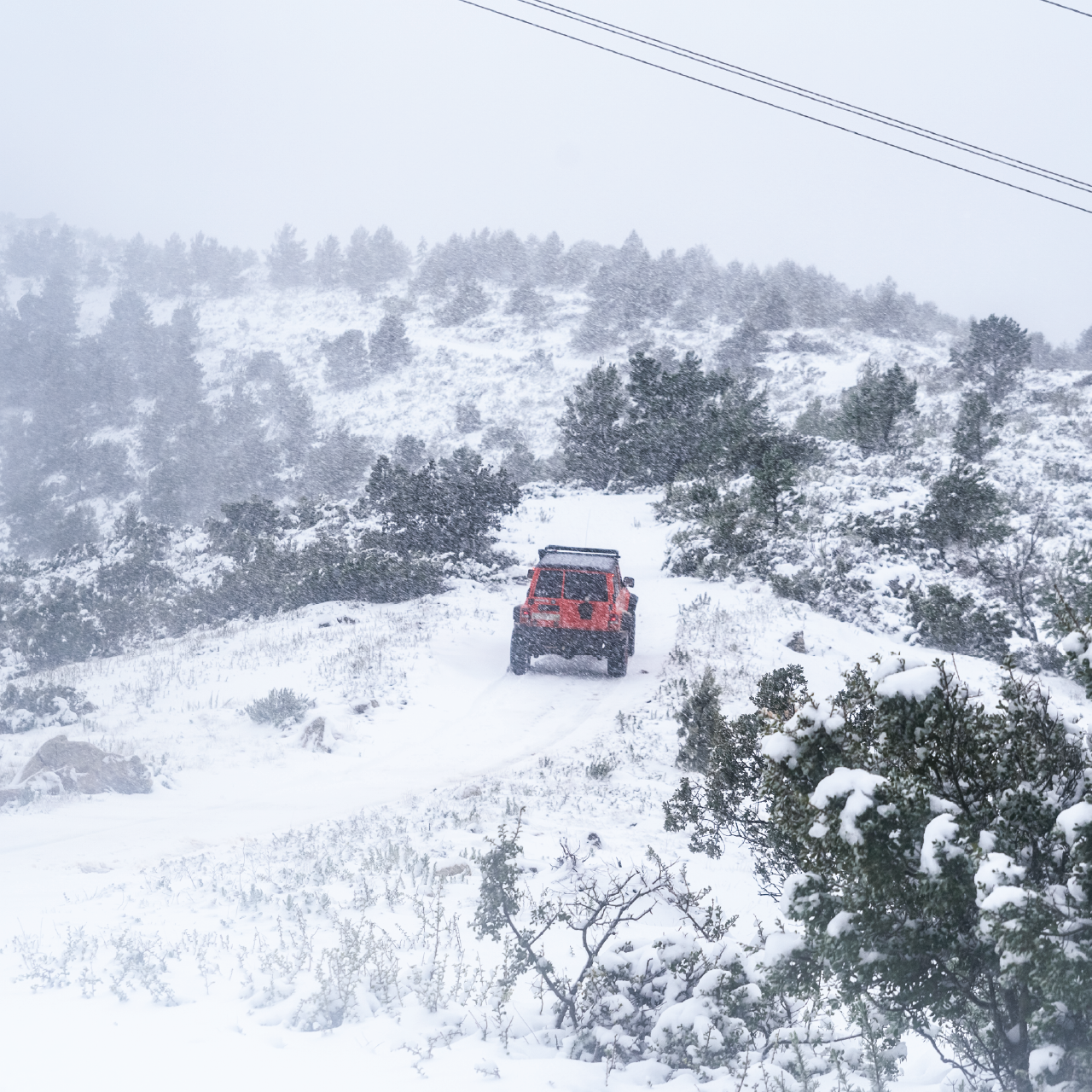
There's something magical about winter wheeling. Fresh powder blanketing the trail, crystalline air, and landscapes transformed into pristine white wilderness. But winter off-roading also presents unique challenges that can turn a beautiful day into a dangerous situation faster than you can say "black ice."
Snow and ice create recovery scenarios that are fundamentally different from mud, sand, or rock. The techniques that work in summer might fail spectacularly in winter, and the consequences of getting stuck in freezing temperatures are more serious than in warmer months. Let's talk about what you need to know to wheel safely and recover effectively when the temperature drops.
Understanding Winter Terrain: It's Not All Created Equal
Before we dive into recovery techniques, you need to understand what you're actually dealing with. "Snow and ice" sounds simple, but winter conditions vary enormously.
Packed Snow vs. Powder
Packed snow can actually provide decent traction. It's been compressed by previous vehicles or natural melting and refreezing cycles, creating a relatively solid surface. This is what you typically encounter on maintained forest roads and popular trails.
Powder snow is the fluffy stuff that looks beautiful but offers almost no traction. Your tires just spin, digging deeper without gaining forward momentum. It's also where you're most likely to high-center your vehicle as you sink into the soft snow underneath.
Ice: The Great Equalizer
Ice comes in different forms, and each presents its own challenges:
Black ice is nearly invisible and offers virtually zero traction. It forms when moisture freezes on cold surfaces and is most common in shaded areas, bridges, and spots where water runs across the trail.
Glare ice is visible, smooth, and equally treacherous. This is what forms when snow melts and refreezes, or when freezing rain coats everything.
Rough ice has texture from repeated freeze-thaw cycles or from being driven on while partially frozen. It offers marginally better traction than smooth ice, but don't get cocky.
The Hidden Danger: Snow Over Ice
The most dangerous condition is fresh snow covering ice. You think you have traction because you're on snow, but underneath is a skating rink. This is where most winter accidents happen—people enter turns at speeds appropriate for snow and discover too late that they're actually on ice.
Pre-Trip Preparation: Winter-Specific Gear
Your summer recovery kit needs winter additions. Here's what should be in your vehicle:
Emergency Warmth: Extra layers, winter coats, gloves, hats, and blankets. If you get stuck and need to wait for help, hypothermia is a real risk. Pack enough for every passenger, plus extras.
Traction Aids: Sand, kitty litter, or commercial traction granules. These can help get you moving when traction boards aren't enough. A 50-pound bag of sand in the bed also adds helpful weight over the rear axle for 2WD trucks.
Snow Shovel: A full-size snow shovel is essential. You'll be clearing more snow than you would dirt, and a bigger shovel makes the job faster. Keep it accessible.
Ice Scraper and Snow Brush: Keep your windows clear. You can't spot hazards or execute recovery if you can't see.
Extra Food and Water: Your body burns more calories in cold weather. If you're stuck and digging, you'll need fuel. Keep high-energy snacks and water (in insulated containers so they don't freeze).
Communications: Cell service is often limited in winter backcountry. Consider a satellite communicator like a Garmin inReach or Zoleo.
Battery Jumper Pack: Cold weather kills batteries. A portable jump starter could be the difference between driving home and spending the night.
Tire Chains: In some winter conditions, even the most aggressive tires won't cut it. Chains provide traction when nothing else will.
Tire Pressure: The Winter Advantage
Airing down in winter works differently than in summer. Lower tire pressure increases your tire's footprint, which helps you "float" on top of snow rather than sinking into it. It also allows your tire to conform to the terrain, improving contact on ice.
Start at 15-20 PSI for packed snow and powder conditions. You can go lower for deep powder, but monitor how your vehicle handles. Remember that extreme cold causes tire pressure to drop naturally—tires lose about 1 PSI for every 10-degree drop in temperature.
Critical reminder: Unlike summer wheeling where you can drive indefinitely at low pressures, in winter you need to be more cautious on icy surfaces at very low pressures. The reduced pressure can make your sidewalls flex more, potentially affecting handling on ice. Find the sweet spot that gives you flotation without compromising control.
Driving Techniques for Snow and Ice
Prevention is always better than recovery. These techniques will keep you moving:
Momentum Is Your Friend (But Use It Wisely)
In powder snow, maintaining smooth, steady momentum is key. Stop and you'll sink and get stuck. But momentum in winter requires finesse—you need enough speed to keep moving, but not so much that you lose control.
The technique: Get your speed up before you enter the deep stuff, then maintain steady throttle. Don't hammer it or you'll just spin. Don't coast or you'll sink. Find the sweet spot where you're moving steadily without breaking traction.
Smooth Inputs on Ice
On ice, treat your controls like they're made of glass. Abrupt steering, acceleration, or braking will break traction instantly.
The technique: Slow down before turns, not in them. Accelerate gently out of corners. If you feel your tires starting to slip, ease off—don't try to power through. Think of ice as having a traction budget, and every input (steering, braking, accelerating) withdraws from that budget. Make your inputs small enough that you never overdraw.
The "Rocking" Method for Being Stuck
If you're stuck but not hopelessly buried, try rocking back and forth. This technique packs snow and can help you build enough momentum to break free.
The technique: Shift between drive and reverse (or 1st and reverse in a manual), using your vehicle's momentum to rock back and forth. Each time you move forward or back, you'll pack the snow a bit more and potentially climb out of your rut. Don't spin your tires—use gentle throttle and let momentum do the work.
Recovery Strategies for Winter Conditions
Despite your best efforts, you'll eventually get stuck. Here's how to recover in snow and ice:
Step 1: Assess Before You Act
Stop spinning your tires immediately. Spinning just polishes the ice underneath your tires and digs you deeper into snow. Get out and look at the situation:
- Are you high-centered on snow?
- Are your tires on ice, packed snow, or powder?
- Can you see a clear path forward or back?
- What's the terrain like around you?
Step 2: Clear and Create
Use your shovel to clear snow from around your tires and under your vehicle. If you're high-centered, you need to dig out enough snow so your chassis isn't resting on it. This is hard work—pace yourself and take breaks.
Once cleared, create a packed path in the direction you want to go. Walk it down, shovel snow to fill low spots, and create the smoothest, most level surface possible.
Step 3: Add Traction
Now place your traction aids. Options include:
Traction Boards: These work well in snow. Place them as close to your tire as possible, angled in the direction you want to go. The trick in snow is to pack the snow around the boards so they don't shift when you start moving.
Sand or Kitty Litter: Sprinkle liberally in front of (or behind, if backing out) your tires. This works better on ice than in deep snow. Non-clumping kitty litter is ideal—it's cheap, provides grit, and absorbs moisture.
Pine Branches or Brush: In a pinch, laying down pine branches or brush can give your tires something to grip. This is an old logger's trick that actually works.
Floor Mats: Rubber floor mats can work like traction boards in a pinch. Place them in front of your tires with the rubber side down for grip.
Step 4: The Gentle Approach
With everything prepped, try to drive out using minimal throttle. In 4WD low if you have it, use second gear (or whatever provides the lowest possible power delivery). The goal is to rotate the tires slowly without breaking traction.
If you have a manual transmission, slipping the clutch to keep wheel speed low is your friend. In an automatic, use your transmission's manual mode to stay in a higher gear for less power delivery.
Kinetic Recovery in Winter: Special Considerations
Kinetic recovery straps work in winter, but with important caveats:
The Good News: Kinetic recoveries can be very effective in snow. The packed snow beneath vehicles often provides enough resistance for the recovery vehicle to get a good pull.
The Bad News: Ice changes everything. The recovery vehicle needs good traction to perform a kinetic recovery. If both vehicles are on ice, you won't generate enough force—you'll just pull the recovery vehicle forward.
Winter Kinetic Recovery Tips:
- Position carefully. Get the recovery vehicle on the most solid ground possible—packed snow or bare ground is ideal.
- Shorten the strap. In winter, you often don't need as much momentum. A shorter strap reduces the risk of the recovery vehicle losing control.
- Go easy. Use less momentum than you would in summer. Ice and snow are slippery, and too much speed can send the recovery vehicle sliding.
- Have a spotter. In winter conditions, communication is crucial. A spotter can watch for ice patches and ensure the recovery vehicle doesn't slide into trouble.
Winching in Winter: The Cold Reality
Winches work in winter, but cold affects their performance:
Battery Capacity Drops: In extreme cold, your battery might only have 50-60% of its normal capacity. This means less power for winching. Keep your engine running at higher RPMs during winch operations.
Metal Gets Brittle: Extreme cold makes steel more brittle. Inspect your cable, shackles, and other metal components extra carefully. What might have held in summer could fail in subzero temps.
Hands Go Numb: Working with metal in freezing temperatures is miserable. Wear good gloves—the kind that balance dexterity with warmth. Having a crew member operate the winch remote while you stay in the warm cab is ideal.
Anchor Points Are Different: Trees are great anchor points, but their trunks can be frozen and more brittle. Snow-covered logs and rocks might seem solid but could be frozen in place with ice, only to break free unexpectedly. Test your anchor points carefully.
Self-Recovery with Traction Aids: Chains and Cables
Sometimes the best recovery tool is prevention. Tire chains dramatically increase your capability in winter.
When to Install Chains: Before you need them. Once you're stuck, installing chains is exponentially harder. If you're heading into questionable conditions, chain up in a safe, level area before the sketchy section.
Front or Rear? For 4WD vehicles, most people run chains on all four corners in serious winter conditions. If you can only run them on one axle, put them on the front for better steering control—though this is a debate with good arguments on both sides.
Cable Chains vs. Link Chains: Cable chains are lighter and easier to install but don't last as long. Traditional link chains provide better traction and durability but are heavier and more difficult to fit properly.
What Not to Do: Winter Recovery Mistakes
Don't Over-Rely on 4WD: Four-wheel drive helps you go. It doesn't help you turn or stop. Overconfidence in 4WD causes more winter accidents than just about anything else.
Don't Use Frozen Gear: If your recovery strap is frozen solid, let it thaw before use. Frozen synthetic materials can be brittle and more likely to fail.
Don't Rush: Cold makes everything harder—your hands don't work as well, metal is harder to manipulate, and you're wearing bulky clothes. Factor in extra time for everything.
Don't Go Alone: Solo winter wheeling is risky. If something goes wrong, cold amplifies every problem. A stuck vehicle in summer is an inconvenience. In winter, it can be life-threatening.
Don't Ignore Hypothermia Signs: Shivering, confusion, slurred speech, and loss of coordination are warning signs. If anyone in your group shows these symptoms, recovery takes a backseat to getting warm.
The Ultimate Winter Recovery Tool: Good Judgment
The best recovery is the one you don't need. In winter, this principle is more important than ever. Turn around if conditions are beyond your skill level or equipment capability. There's no shame in recognizing that a trail is too sketchy for the conditions.
Check weather forecasts before heading out, and have a bailout plan if weather deteriorates. Let someone know your route and expected return time. Carry the ten essentials plus winter-specific extras. And remember: trails will be there in spring. You only get one life.
Practice Makes Perfect (And Warm)
Find a safe, open area—an empty snow-covered parking lot is ideal—and practice winter driving techniques when the stakes are low. Learn how your vehicle behaves on snow and ice, practice recoveries with your gear, and get comfortable with winter conditions before heading into the backcountry.
Time spent practicing in a parking lot will make you exponentially more capable and confident when you're on a real trail.
One Last Thing: Respect Winter
Winter doesn't care about your schedule, your ego, or your expensive equipment. It's an environment that demands respect, preparation, and humility. But for those willing to prepare properly and approach it thoughtfully, winter wheeling offers some of the most beautiful, peaceful, and rewarding off-road experiences you'll ever have.
The snow is falling, the trails are calling, and adventure awaits. Bundle up, bring the right gear, and stay safe out there.